If you or someone you care for has a disability that makes garden maintenance difficult or impossible, the National Disability Insurance Scheme (NDIS) may be able to fund professional gardening services. But navigating what is covered, how much it costs, who can provide it, and how to actually get it set up can feel overwhelming.
This guide covers everything — from eligibility and funding rules to exact line item codes, current pricing rates, plan management types, seasonal budgeting, and even what to do if you are unhappy with your provider. No jargon, no gaps.
1. Why Garden Maintenance Matters for NDIS Participants
A garden might seem like a low priority compared to other disability supports, but for many people it is deeply connected to their safety, independence, and mental health. Here is why it matters:
Safety
Overgrown grass hides uneven ground, tree roots, and debris all of which are serious trip and fall hazards. This is particularly dangerous for participants who use wheelchairs, walkers, or crutches, or who have balance difficulties due to their disability. Long grass also becomes slippery when wet, and overhanging branches can obstruct ramps and access routes.
Independence and Dignity
Being unable to look after your own home environment can feel humiliating and disempowering. NDIS gardening support is not charity — it is a reasonable accommodation that allows you to live on equal terms with people who do not have a disability. A tidy, accessible outdoor space means you can hang washing, check the letterbox, enjoy fresh air in your courtyard, or simply feel proud of your home.
Mental Health
Research consistently links unmanaged home environments with increased anxiety, depression, and feelings of helplessness. Knowing that a professional will keep your outdoor space under control removes a significant source of daily stress. Many NDIS participants report that having a well-maintained garden dramatically improves their sense of wellbeing and control over their life.
Property Safety
Unmanaged gardens can cause long-term damage. Invasive weeds crack paths and foundations, overgrown hedges can break fences, and leaf build-up blocks gutters and drains. Regular garden maintenance protects the value and structural integrity of your home, whether you rent or own.
Note: If you are interested to get NDIS Services Our Recommendation is: NDIS Gardening Services With Warrior Home Management
2. Will the NDIS Fund My Gardening?
The NDIS will fund garden maintenance if it meets the Reasonable and Necessary criteria. This is the key test every support must pass. It means the support must:
- Be directly related to your disability (not something you would need regardless of disability)
- Help you pursue your goals, live independently, or participate in the community
- Represent value for money
- Not be the responsibility of another system (e.g. state housing, aged care)
- Not be something a family member or housemate can reasonably do for free
In practical terms, if your disability physically prevents you from mowing, weeding, pruning, or tidying your garden — and you have no one in the household who can do it — then garden maintenance will almost always qualify.
What if I Live with Other People?
This is one of the most commonly misunderstood rules. If you share a home with a partner, family member, or housemate who is capable of doing garden work, the NDIS may only fund maintenance of the areas you use independently — for example, your personal courtyard, access path, or small private outdoor area.
However, if everyone in the household has a disability, or if the shared outdoor space is primarily needed for your accessibility and safety, the NDIS may fund the full property. Always discuss your specific situation with your Support Coordinator or Local Area Coordinator (LAC).
What if I Rent?
NDIS gardening support is available to participants regardless of whether they own or rent their home. The funding helps you maintain the immediate outdoor environment that affects your daily safety and independence.
| Quick Eligibility Checklist
• You are a current NDIS participant • Your disability prevents you from doing garden maintenance safely • You do not have a household member who can reasonably do it • You have Core Supports funding in your plan • The tasks requested are essential (not purely cosmetic) |
3. What Exactly Is Covered and What Is Not
What the NDIS Will Fund
NDIS-funded gardening covers essential maintenance tasks that directly support your safety and ability to live at home. These include:
Lawn Mowing and Edging
Regular mowing keeps grass from becoming overgrown, which reduces trip hazards and makes outdoor spaces safe to move through. Edging creates clear, defined boundaries between lawns and pathways, making navigation safer — especially for participants who use mobility aids.
Weeding
Weed removal from garden beds, paths, driveways, and lawn areas is covered. Persistent weeds can crack concrete paths and harbour pests and mould, which pose health risks — particularly for participants with respiratory conditions, allergies, or immune vulnerabilities.
Pruning and Hedge Trimming
Overgrown branches and hedges can block doorways, driveways, windows, and access ramps. Pruning keeps these obstacles clear and also keeps plants healthy. Trimming hedges maintains sightlines and prevents branches from becoming safety hazards in storms.
Green Waste Removal
After completing garden work, your provider should remove all clippings, branches, leaves, and debris. A tidy finish is part of the service.
Whipper Snipping and Blowing
Trimming around fences, garden edges, and hard surfaces (whipper snipping) and clearing debris with a leaf blower are both included as standard yard maintenance tasks.
Basic Garden Cleanup
Clearing fallen leaves from paths, removing storm debris, and keeping outdoor areas accessible — especially after heavy rain or during autumn — falls under general yard maintenance.
Pressure Washing (Where Disability-Related)
Some providers offer pressure washing of paths and driveways. This can be funded if slippery or dirty paths are a direct safety hazard related to your disability.
What the NDIS Will NOT Fund
Understanding what is excluded is just as important as knowing what is covered. The NDIS does not fund:
- Materials and consumables: soil, mulch, fertiliser, seeds, new plants, or pots — the NDIS pays for labour only
- Decorative landscaping: creating new garden beds, installing water features, garden design, or aesthetic improvements
- Tree removal or major tree work: this is typically a specialist service anyone might need and is not disability-specific
- Irrigation system installation or repair
- Pest control or spraying (unless directly linked to disability-related health risk and pre-approved)
- New lawn installation or turf laying — this is a capital improvement, not maintenance
- Pool cleaning or maintenance
4. How Garden Maintenance Is Funded in Your NDIS Plan
Support Category and Line Item
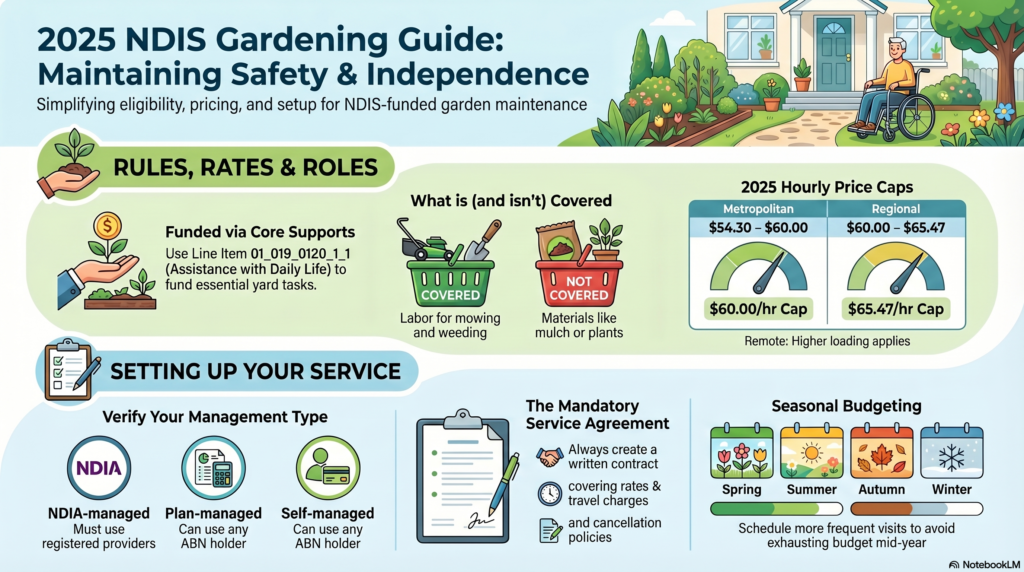
NDIS garden maintenance is funded under:
| Detail | Information |
| Support Category | 01 — Assistance with Daily Life |
| Support Sub-Category | Assistance with Daily Life |
| Line Item Code | 01_019_0120_1_1 |
| Line Item Name | House and/or Yard Maintenance |
| Budget Type | Core Supports |
This line item specifically covers performing essential yard activities that a participant is unable to do themselves because of their disability.
The Core Supports Budget How It Works
Core Supports is the most flexible part of your NDIS plan. If you have Core funding, you can direct it towards gardening without needing a specific line for ‘gardening’ to appear in your plan. The category covers a range of daily living supports, and gardening falls within it.
This means that if you have Core Supports funding allocated for general daily living, you can start using it for garden maintenance right away — you do not need to wait for your next plan review to add gardening specifically.
Can a Support Worker Do My Gardening Instead?
Yes. Another option is to have a Support Worker assist you with garden tasks as part of their role supporting your daily living. This is funded under ‘Assistance with Personal Domestic Activities’ — also within Support Category 01. If your Support Worker has the skills and capacity to help with basic garden tasks, this can sometimes be a more flexible option.
5. NDIS Gardening Rates and Pricing (2026)
One of the most common questions is: how much does NDIS-funded gardening cost, and how does pricing work?
Current Hourly Rates
Under the NDIS Pricing Arrangements and Price Limits (updated July 2025), the capped hourly rate for yard maintenance and gardening generally falls between:
| Region | Approximate Hourly Rate Range |
| Metropolitan areas | $54.30 – $60.00 per hour |
| Regional areas | $60.00 – $65.47 per hour |
| Remote areas | Higher loading may apply |
Important: These rates are price caps set by the NDIS. Providers cannot charge above these amounts. However, providers can charge below the cap so it is worth comparing providers.
What the Rate Includes
The hourly rate must cover all of the following:
- Labour performed by the gardener or support worker
- All tools and equipment needed to complete the work
- Green waste removal and general cleanup after the job
- Any incidental costs related to the service
Providers cannot add separate charges for equipment hire, fuel for machinery, or disposal fees on top of the hourly rate. If they have genuine additional costs, these must be factored into the agreed hourly rate not billed separately.
Travel Charges
Providers can charge for travel time to reach your property. The standard NDIS allowances are:
- Up to 30 minutes travel time in metropolitan areas
- Up to 60 minutes travel time in regional areas
Always ask about travel charges before you sign a service agreement. Your provider should be transparent about whether they charge for travel and how much it adds to your bill.
Invoicing Rules
Providers must invoice by the hour — the NDIS does not accept flat-fee invoicing for garden maintenance jobs. Your invoice should show the date of service, the hours worked, the hourly rate (including GST), and the total amount claimed. Keep copies of all invoices for your records.
6. Plan Management Types: Who Can You Use as a Provider?
Your plan management type determines whether your gardening provider needs to be registered with the NDIS. This is important — getting it wrong can cause payment problems.
| Plan Management Type | Who Can You Use? |
| NDIA-Managed (Agency-Managed) | Must use a registered NDIS provider only |
| Plan-Managed | Can use registered OR unregistered providers (must have a valid ABN) |
| Self-Managed | Can use registered OR unregistered providers (must have a valid ABN) |
What Does ‘Registered’ Mean?
A registered NDIS provider has been vetted and approved by the NDIS Quality and Safeguards Commission. They meet specific standards for quality, safety, and accountability. However, many excellent local gardeners and lawn care businesses are unregistered simply because the registration process is time-consuming for small businesses — it does not mean they are lower quality.
Unregistered Providers: What You Need to Check
If you are plan-managed or self-managed, you can use unregistered gardeners. Before you do, verify:
- They have a valid Australian Business Number (ABN) you can check at abn.business.gov.au
- They can invoice correctly (date, description of service, hourly rate, GST)
- They understand the NDIS invoicing requirements (no flat fees, no separate material charges)
- They have appropriate insurance (public liability at minimum)
7. How to Get Started: Step-by-Step
Step 1: Check Your Current Plan
Log into the myNDIS portal or contact your plan manager and check whether you have Core Supports funding. Even if ‘gardening’ is not specifically mentioned.
Step 2: Find a Provider
You have several ways to find a suitable gardening provider:
- Search the NDIS Provider Finder at ndis.gov.au (for registered providers)
- Ask your Support Coordinator or LAC for recommendations
- Ask friends, family, or neighbours with NDIS plans who they use
- Search local gardening businesses and confirm they have an ABN and understand NDIS invoicing
Step 3: Interview Providers
Before committing, ask potential providers these key questions:
- What is your hourly rate, inclusive of GST?
- Do you charge for travel time, and if so, how much?
- Are you familiar with NDIS invoicing requirements?
- What equipment do you bring, and is it included in your rate?
- Do you handle green waste removal?
- Can you provide a written service agreement?
- Are you available for regular ongoing services or one-off visits?
Step 4: Set Up a Service Agreement
Always create a written service agreement before work begins. This is a simple document that should cover:
- Your name and NDIS participant number
- The provider’s name, ABN, and contact details
- A clear description of what services will be provided
- How frequently services will occur
- The agreed hourly rate, including any travel charges
- How invoicing and payment will work
- Cancellation policies what happens if you or the provider need to reschedule
A service agreement protects both you and your provider. It prevents misunderstandings and gives you something to refer back to if a dispute arises.
Step 5: Start Services and Track Your Spending
Once your service agreement is in place, work can begin. Keep records of every service visit date, hours worked, and cost. Your plan manager can help you track your Core budget balance. Monitoring your spending prevents you from running out of funding mid-year.
8. What to Do If Gardening Is Not in Your Current Plan
Did not think to include gardening when your plan was set up? You have options.
Request a Plan Review
If your circumstances have changed your disability has progressed, you have moved to a property with a garden, or your previous support arrangements have fallen through you can request a plan review. Contact your Support Coordinator or LAC and explain the change in circumstances.
Gather Supporting Evidence
A plan review request is much more likely to succeed with supporting documentation. Useful evidence includes:
- A letter from your GP or specialist explaining how your disability prevents you from doing garden maintenance
- An Occupational Therapist (OT) report recommending garden maintenance as a necessary support
- Photos of your current garden situation
- A written statement from you explaining the impact on your safety and independence
Use Your Existing Core Budget While You Wait
If you already have Core Supports funding in your plan, you may be able to start using gardening services immediately under the general daily living category even before a formal plan review. Check with your plan manager or Support Coordinator to confirm.
9. Seasonal Planning and Budgeting
One area that almost no other guide covers is how to budget for NDIS gardening throughout the year. Garden maintenance needs change significantly by season, and your Core Support budget is finite. Smart planning means you do not run out of funding during summer when your lawn needs the most attention.
| Season | Typical Garden Needs |
| Spring (Sep–Nov) | High mowing frequency (every 2 weeks), pruning, weeding, cleanup after winter |
| Summer (Dec–Feb) | Highest mowing frequency (weekly in warm areas), ongoing weeding, edging |
| Autumn (Mar–May) | Leaf clearing, reduced mowing, pre-winter pruning, hedge trimming |
| Winter (Jun–Aug) | Minimal mowing, light maintenance, path clearing after rain |
Budgeting Tips
- Work out your annual gardening cost by estimating visits per month across the year
- Discuss seasonal scheduling with your provider at the start of the year
- Build a small buffer into your estimates unexpected storms, fast-growing seasons, or price adjustments can push costs higher
- Ask your plan manager to flag when your Core budget reaches 25% remaining so you have time to adjust
- If your plan runs July-to-June (Australian financial year), remember that summer falls in the second half plan accordingly
10. FAQs: Answers to Questions Other Guides Miss
Can I get NDIS gardening services for a property I am about to move into?
Not before you live there. NDIS supports are tied to your current home environment and daily living needs. Once you move in, you can arrange services under your existing Core budget.
My landlord says I am responsible for the garden does the NDIS cover it?
If the garden is part of your tenancy and your disability prevents you from maintaining it, the NDIS can fund the labour involved. However, the NDIS does not cover costs that are the tenant’s responsibility beyond labour such as replacing plants you were expected to maintain.
What happens if my gardener does not show up?
Your service agreement should include a cancellation and no-show policy. A reputable provider will reschedule at no additional charge if they cancel. If you cancel with less than the agreed notice period, you may be charged a cancellation fee (this should be specified in your agreement). Document any no-shows and address them with the provider directly. If the problem is ongoing, you have the right to end the service agreement and find a new provider.
Can I use my NDIS gardening funding to hire a family member?
You can hire a family member as your gardening provider, but there are strict rules. They must have a valid ABN, invoice correctly at the NDIS rate, and in most cases cannot be a parent, guardian, or spouse of the participant unless you are self-managed. Check the current NDIS rules or ask your plan manager before arranging this.
Is there a minimum or maximum number of gardening visits I can have?
No set limits. The frequency of visits is determined by your needs, your property, and your available Core Support budget. Most participants in active growing seasons arrange services every two to four weeks. Your plan manager can help you work out what is sustainable within your funding.
What if the gardener damages something in my yard?
This should be covered by your provider’s public liability insurance. Before engaging any provider, confirm they hold current public liability insurance. If damage occurs, document it with photos and notify the provider in writing immediately. If the matter cannot be resolved, you can escalate to the NDIS Commission.
Can the NDIS pay for gardening tools or equipment for me to use myself?
Assistive technology or equipment that helps you complete tasks independently may be funded but it would fall under a different support category (typically Assistive Technology or Home Modifications) and would require an OT assessment. It would not be funded through the gardening line item.
11. Your Rights as an NDIS Participant
This section is almost entirely absent from other articles on this topic. As an NDIS participant accessing gardening services, you have rights that are worth knowing:
Right to Choose Your Provider
Unless you are NDIA-managed (agency-managed), you have the right to choose any provider with a valid ABN. No one including a support coordinator can force you to use a particular gardening company.
Right to End a Service Agreement
If you are unhappy with a provider, you can end your service agreement. Review the notice period in your agreement (typically 2 to 4 weeks) and inform the provider in writing. You are not locked in permanently.
Right to a Clear Invoice
Every invoice must clearly show the date, hours worked, hourly rate (including GST), and total amount. Vague invoices or flat-fee billing is not compliant with NDIS requirements. You can refuse to approve a non-compliant invoice.
Right to Make a Complaint
If you believe a provider has done the wrong thing overcharged, provided poor service, or treated you disrespectfully you can make a complaint to the NDIS Quality and Safeguards Commission at 1800 035 544 or ndiscommission.gov.au.
Right to an Accessible Service
Your gardener should communicate with you in a way that works for you. If you need written appointment reminders, a support person present during visits, or any other reasonable adjustment, you can request it.
12. Tips for Getting the Best Out of Your NDIS Gardening Service
- Walk your gardener through your property on the first visit and point out any areas that need special attention or must be avoided
- Take photos before and after each visit this gives you a record and helps you assess quality
- Communicate changes quickly: if a section of the garden has become a priority (e.g after a storm), notify your provider in advance
- Book ahead for busy periods spring and summer gardeners fill up fast
- Give feedback regularly: good providers welcome it and bad providers need it
- Review your service agreement annually when your plan renews rates, frequency, and needs change
- If your garden needs major work after neglect, do a one-off heavy-duty visit before setting up a regular maintenance schedule
13. Quick Reference Summary
| Topic | Key Information |
| NDIS Line Item | 01_019_0120_1_1 — House and/or Yard Maintenance |
| Support Category | Core Supports — Assistance with Daily Life (Category 01) |
| Current Hourly Rate | $54.30 – $65.47 per hour (July 2025, varies by region) |
| What Is Covered | Mowing, edging, weeding, pruning, green waste, whipper snipping, basic cleanup |
| What Is NOT Covered | Materials, plants, landscaping, tree removal, new lawn installation |
| NDIA-Managed Plans | Registered providers only |
| Plan-Managed / Self-Managed | Any provider with a valid ABN |
| Provider Requirement | Valid ABN, hourly invoicing, public liability insurance |
| Travel Charges Allowed | Up to 30 mins (metro), up to 60 mins (regional) |
| Service Agreement | Always required — protects both parties |
| To Get Gardening Added | Request a plan review; get OT or GP supporting letter |
| Complaints | NDIS Quality and Safeguards Commission: 1800 035 544 |
Final Thoughts
NDIS gardening services are not a luxury they are a practical, disability-related support that helps participants stay safe, independent, and comfortable in their own homes. With the right provider, a clear service agreement, and a basic understanding of how your funding works, garden maintenance is one of the more straightforward supports to set up and manage.
If you are unsure where to start, talk to your Support Coordinator or Local Area Coordinator. Bring this guide with you. Ask questions. You are entitled to clear, plain-language answers.
Your outdoor space should work for you not against you.